
What if your employees could delegate some of the personal tasks competing for their time and attention, just as they delegate tasks at work?
Key takeaways
- A virtual concierge service provides your employees with remote access to professional concierges who can help with research, planning, scheduling, coordination, and completing personal tasks.
- Unlike a resource library, a concierge provides hands-on assistance getting everyday tasks off your employees’ to-do lists.
- Because the service isn’t tied to a physical workplace, you can extend the benefit to remote, hybrid, multisite, and geographically dispersed employees.
- The value isn’t simply access to an app or platform. It’s giving your employees a person they can turn to for help when life gets busy.
Your employees bring their personal lives to work. They have child care to research, home repairs to schedule, trips to plan, or purchases to make. While those responsibilities may exist outside the workplace, the research, planning, scheduling, and mental load behind them don’t always fit neatly outside the workday.
A virtual concierge gives your employees a practical way to hand off some of that work, wherever they happen to work.
What is a virtual concierge?
A virtual concierge service is an employee work-life benefit that provides your employees with remote access to professional concierges who can assist with personal tasks.
Instead of handling every step themselves, your employees can delegate some of the time-consuming legwork involved.
For example, an employee who needs someone to repair a dishwasher may need to search for local companies, read reviews, compare availability, request estimates, and make calls. A virtual concierge can take on some of that research and coordination.
That distinction matters when you’re evaluating work-life benefits. A virtual concierge isn’t simply another resource library that tells your employees where to look for help.
The concierge helps do the work.
How does a virtual concierge service work?
With BEST’s Virtual Concierge Service, employees can submit requests through an app, online portal, email, text, or phone, with 24/7 access to the app for submitting requests. Once a request is received, the concierge handles the appropriate research, coordination, or planning.
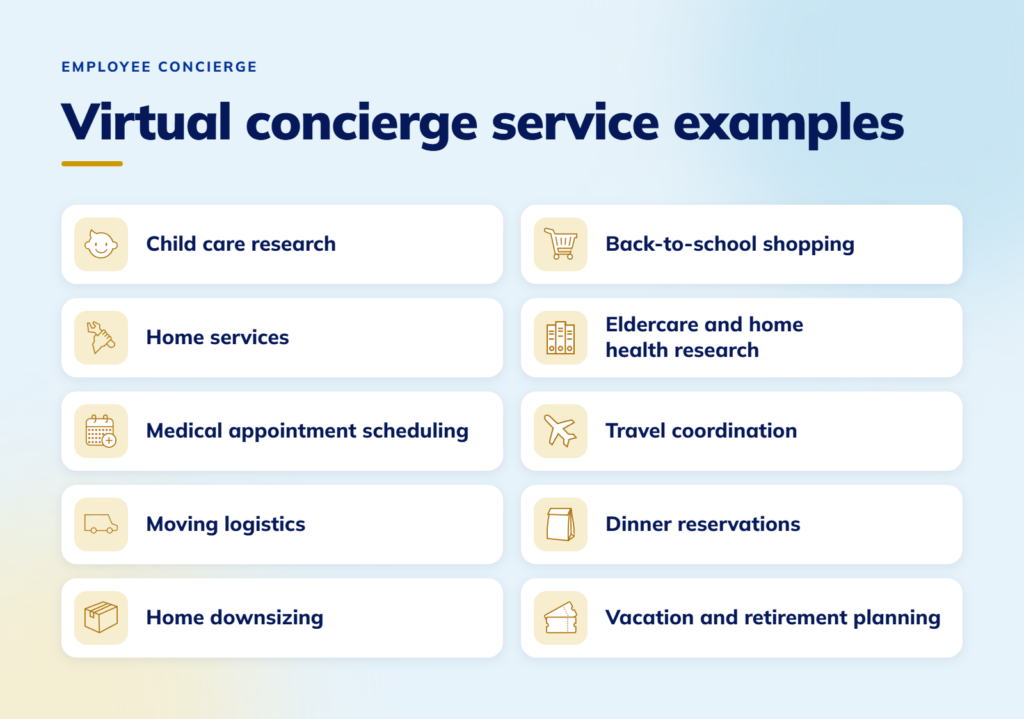
What can a virtual concierge help your employees with?
Virtual concierge services generally focus on tasks that can be researched, arranged, purchased, booked, or coordinated remotely.
The types of requests can change as your employees move through different stages of life, making the benefit relevant across a multigenerational workforce.
What is the difference between an on-site and virtual concierge?
An on-site concierge is physically located at your workplace. A virtual concierge provides assistance remotely.
With an on-site program, your employees can visit the concierge in person, which can be particularly useful for services involving items employees bring to or pick up from the workplace.
A virtual concierge isn’t tied to a particular building. Employees communicate digitally or by phone, and the concierge focuses on services that can be executed remotely.
For human resource and benefits leaders managing remote, hybrid, or multisite workforces, that flexibility can help you provide concierge support without requiring a physical concierge desk at every location.
Neither model inherently replaces the other. They’re simply different ways of delivering concierge support.
Why offer virtual concierge as a work-life benefit?
Your benefits strategy may already address health care, retirement, financial wellness, mental health, caregiving, and family formation. A concierge service approaches work-life support from another angle: the time and effort required to manage everyday life.
Even relatively simple personal tasks can require researching options, comparing costs, making calls, coordinating schedules, and following up. Individually, those steps may seem small. Collectively, they consume time and attention.
A virtual concierge gives your employees a way to delegate some of that work.
The flexibility of the service also allows employees to use it in different ways throughout their lives and careers.
Because employees can access the service through an app, portal, email, text, or phone, the benefit can also extend across offices, states, and work arrangements.
A concierge service can’t solve every work-life challenge your employees face. But it can give them something tangible: another set of hands to help manage the everyday responsibilities competing for their time and attention.

Frequently asked questions about virtual concierge services
What is a virtual concierge service?
A virtual concierge service is a work-life benefit that gives your employees remote access to professional concierges who assist with personal tasks such as research, scheduling, shopping, travel planning, reservations, and vendor coordination.
What does a virtual concierge do?
A virtual concierge handles tasks that can be completed or coordinated remotely. This can include researching child care or eldercare, comparing vendors, planning travel, shopping online, coordinating home repairs, making reservations, and planning events.
How is a virtual concierge different from an on-site concierge?
An on-site concierge is physically located at your workplace. A virtual concierge provides support remotely through channels such as an app, website, email, phone, or text. Both help your employees manage personal responsibilities, but their delivery models differ.
Is a virtual concierge a work-life benefit?
Yes. You can offer virtual concierge as an employee work-life benefit because it provides practical assistance with personal responsibilities that require your employees’ time and attention.
Can your remote employees use a virtual concierge?
Yes. Because the service isn’t tied to a physical workplace, virtual concierge can support your remote, hybrid, and geographically dispersed employees.
Is virtual concierge only for executives?
No. BEST’s Virtual Concierge Program is structured as an employee benefit rather than an executive-only service. Client data included in BEST’s materials shows use across multiple age groups and life stages.
What is the main purpose of a virtual concierge?
At its simplest, a virtual concierge gives your employees a way to delegate some of life’s time-consuming tasks. Instead of managing every search, phone call, comparison, reservation, and scheduling detail themselves, they have a resource to help carry some of the workload.